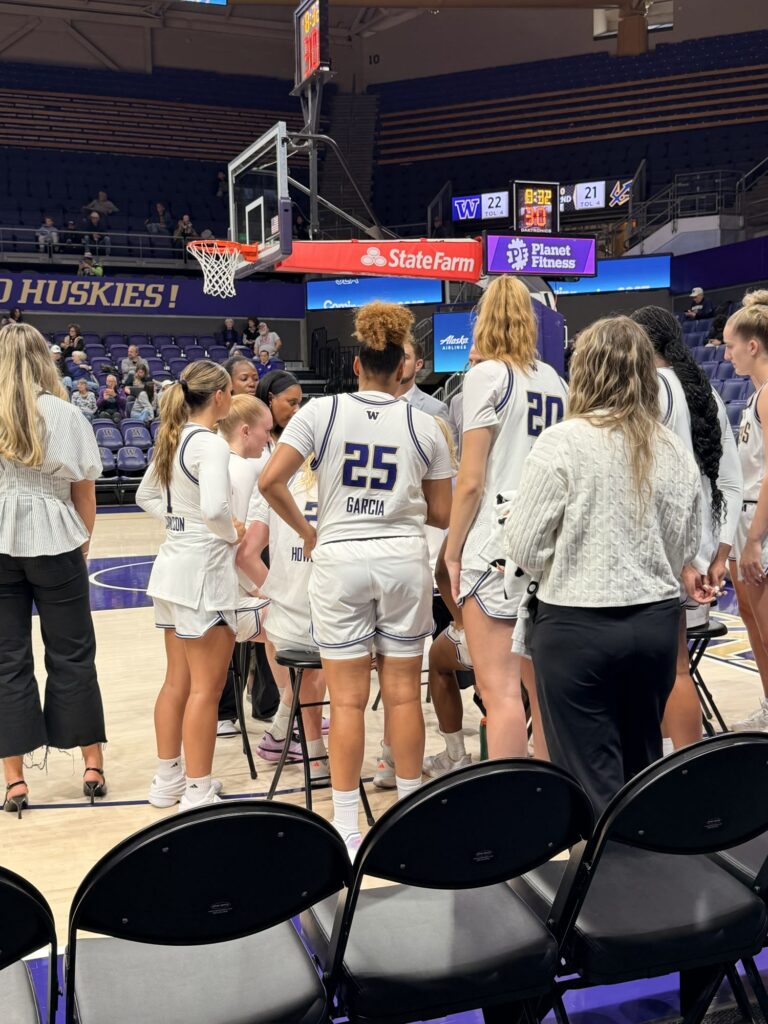
The first shot Amayah Garcia took in a college game was a layup, and she missed it. She grabbed her own rebound and went right back up. She missed that one too.
So when she went up for a third layup, at Alaska Airlines Arena on a Monday morning in November, she was thinking one thing.
“I was like, ooh, just please go in,” she said.
It almost didn’t. For a moment she was sure it was rolling out. Up in the stands, her family held its breath with her.
Her brother Omuiri couldn’t even do that out loud. He was watching from work, trying to keep quiet.
It fell. Her first college basket. And for about a second, that was all it was.
“After that, I was really just worried about getting back on defense,” she said. “At the time, I didn’t really feel too much.”
She was already on to the next play.
Ask her what it means to play Division I, and she’s honest about it.
“I don’t really appreciate that part enough, just because I’ve been playing basketball for so long,” she said. “I knew I had to make it one way or another.”
Part of that is Tasha Brown, Washington’s associate coach and defensive lead, Coach T to the players. She works with them on what they call framework, the mental side of the game.
Coach T gave her two words. A preset is what you decide before you walk on the floor. Amayah’s, for her first college game: “Just be calm, play free, and just go out there and do what I can to help the team win.”
A reset is what you do after something goes wrong. “You got a routine that you do to think, like, next play,” she said, “and just get yourself back in the game.”
She needs it. A month into campus life, she wrote on this site that trying not to look like a freshman was the thing making her look like one.
In that first game, her coach kept yelling for her to be more physical. “There’s a lot of other things you’re thinking about so much at one time,” she said. “You can overthink a lot.”
Her family felt it for her.
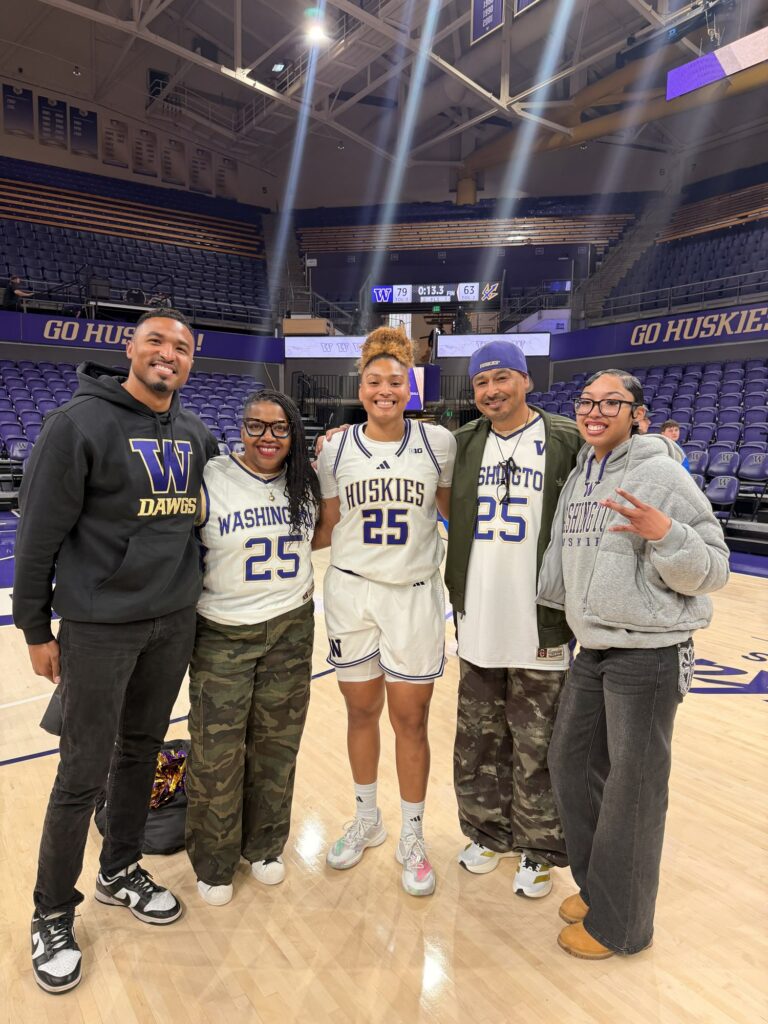
Her parents, Joe and Nikki, sat in white No. 25 jerseys, with her sister Kassidy and her brother Jared beside them.
The night before, Nikki hadn’t known what the moment would do to her. “I don’t know how I’m going to feel once I see her actually step out on the court,” she said. “I hope I don’t cry.”
What Nikki wanted to tell her was simple. “Just play your game. Be you.”
Kassidy had instructions of her own. “Girl, this is your moment,” she said. “I’m gonna be screaming for you. Don’t listen to Mom and Daddy. Listen to the coaches.”
Amayah knows what it cost to get all of them into one row. “I know my parents have sacrificed a lot for me,” she said.
“For them to be able to come to my first college game and see my first bucket, and just be there supporting me like they always have, it just feels good.”
Her first team had no other girls on it, because there was no girls’ team. She played with the boys. From there it was Young Women’s Leadership Academy, then Faith Family Academy in Dallas.
“I just, I don’t think I ever saw this,” Nikki said. “She truly did get it off of just her hard work. Dribbling that ball outside, going to the parks, playing AAU.”
Even on the best teams, Amayah says, she got overlooked. It wasn’t until her junior year of high school that she started to believe she was more than a role player.
When Washington recruited her, what won her over was how the people made her feel.
“It felt really genuine,” she said. “It didn’t feel fake or forced or anything like that. I felt like real love.”
She trusted her own read, and Nikki’s. “My mom, I feel like she has good discernment,” Amayah said, “so she could feel it too.”
Two months in, she says it hasn’t worn off. “The love never faded,” she said. Even the transfers she hadn’t met when she signed “are like sisters to me now.”
Her goal for the season is not small. “Win a national championship if we can get there,” she said. “Or at least just make a run.”
Washington won that first game 79-63, on a day when Sayvia Sellers posted the third triple-double in program history. Amayah came off the bench for 22 minutes, as many as starting guard Devin Coppinger.
Her line said two points. Nesto Roland of UDUBWBB.com wrote that her debut “quietly made one of the biggest impressions of the night.”
Omuiri had a prediction before game two, the first he would see in person. “As soon as she finds that shot and them threes start falling,” he said, “it’s going to get real scary.”
That night against Pacific, she took two threes and made both, the first of her college career. Joe has his own story about that shot.
By the weekend, Roland was writing about a “bully-ball” battle between Amayah and Coppinger. It was a fight for the same job: the guard who wins loose balls, fights through screens and makes life uncomfortable from the opening tip.
The feeling caught up with her later, on a screen.
“After just looking at it and watching the videos back, I really felt the love,” she said. “It was good to see how excited everybody got.”
Some things she didn’t need a replay to feel. After the win over UC San Diego, kids crowded the edge of the court with posters and Sharpies, hoping for a name on something.
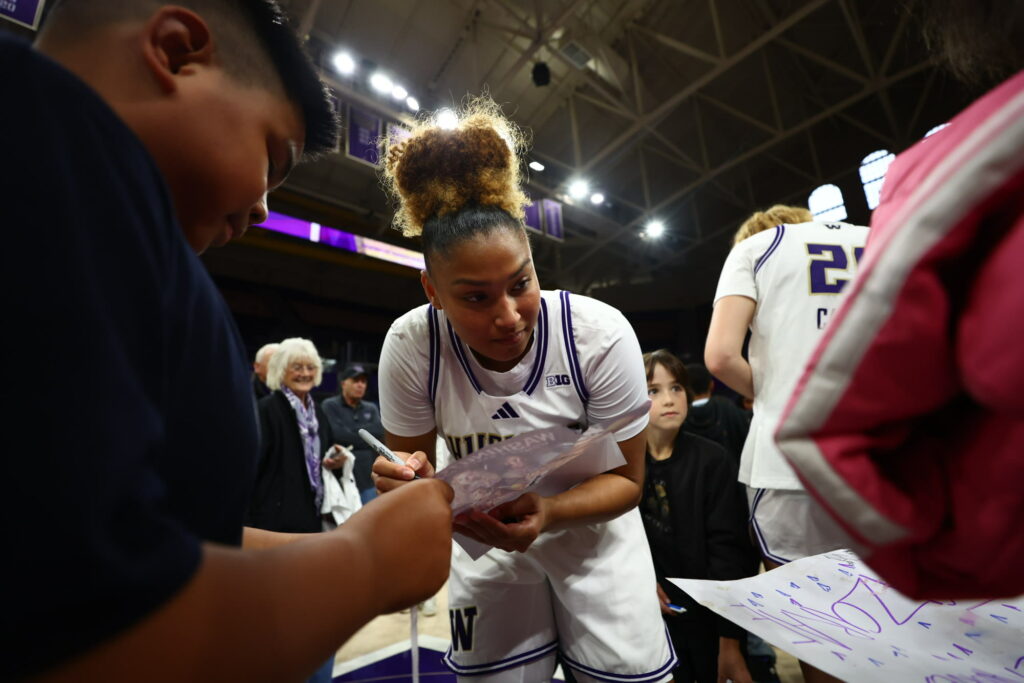
“It actually means a lot,” she said. “Because I remember that used to be me. I used to be going to the college games, being a ball girl, and just wanting an autograph and wanting a poster signed.”
She signed until the line ran out.
“Now I’m the one signing stuff.”
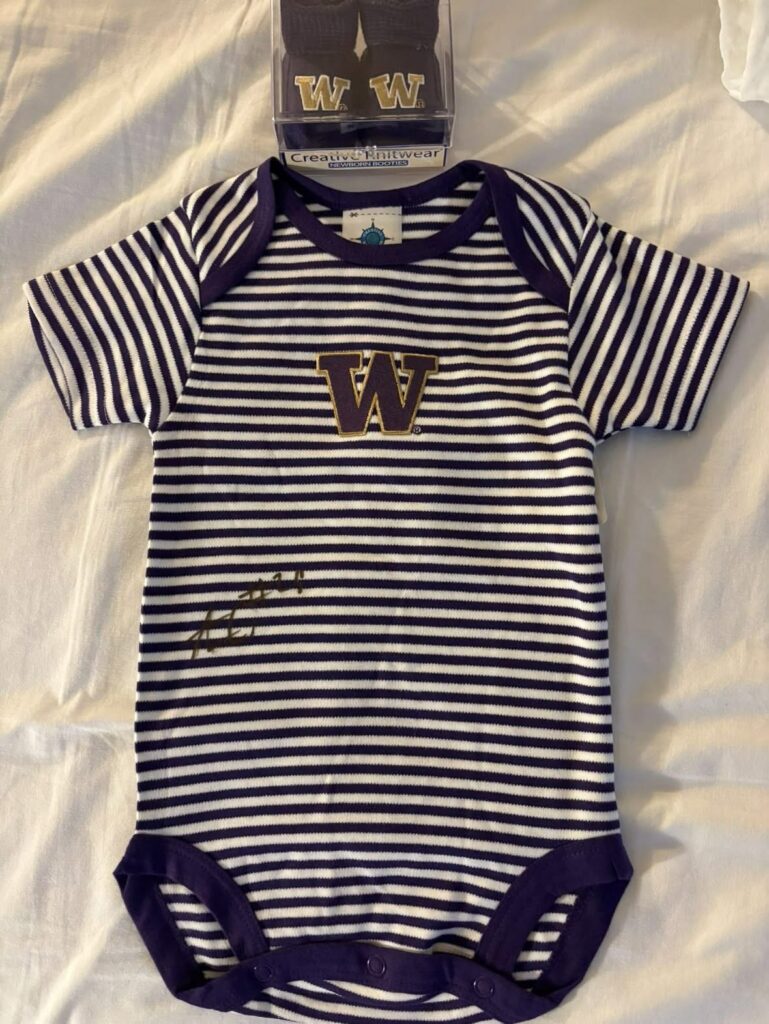
One of the things she has signed since is smaller than any poster. It is a purple-striped Washington onesie, with a pair of tiny W booties beside it, for Jared’s son.
He isn’t here yet. He’ll be the first grandchild in the family and the first nephew for all of his aunts and uncles. He’ll have her autograph before he can hold a Sharpie.
Not every kid in that line will get the looks they think they deserve. Amayah didn’t, for a long time. So if you’re one of them, she has something for you.
“Just keep doing what you’re doing. I know it may not seem like you’re doing a lot, or your role is very little or limited, and you’re not getting the looks that you think you should get. But just stay the course, because it’ll all work out.”